Meet the board
Find the ranks, files, and squares, and learn which way the board faces.

WeLearn Kids · Chess in English
Children ages 8–12 learn how the pieces move, solve puzzles, and use English to explain their moves. Lessons are available in Bucaramanga or online, depending on the session.
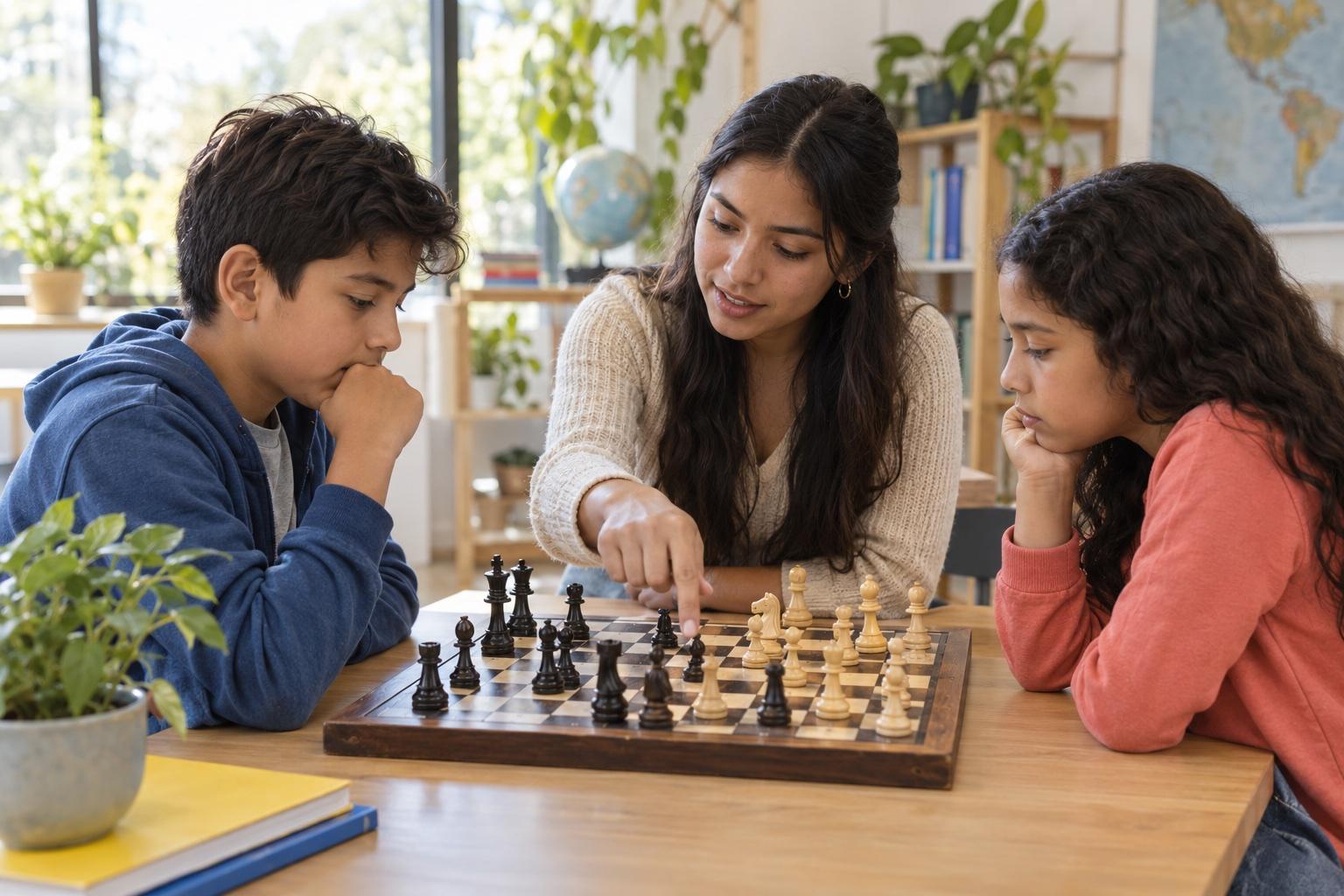
Illustration of a guided chess activity.
How the lessons work
Play a guided position or game and talk about their moves using English that fits their level.
Children start with the board and the pieces. They practice legal moves, spot threats, and solve short puzzles before playing guided games. Beginners can start from the basics.
The board gives children something to point to and do. They put words such as king, move, capture, safe, and check into action as they play.
A child learns to follow an instruction, choose an option, and give a simple reason. They might start with “knight” or “to e4” and build up to “I move my knight because…”
The goal is to understand instructions and speak with confidence while learning the basics of chess.
Learning path
We can group these steps based on a child’s experience, the session length, and the lesson format.
Find the ranks, files, and squares, and learn which way the board faces.
Name the pieces and practice how each one moves.
Find captures, threats, defenses, and safe squares in short puzzles.
Take turns and play legal moves in a guided position.
Use a sample sentence to say what you moved, where it went, and why.
Board demo
Try the move guides and see what happens when you get a move right or wrong.
Sample challenge
A short position gives children one idea to focus on as they listen, move, and explain.
“Your king is in check.” Find your king and the piece attacking it.
See if you can move the king, block the attack, or capture the attacking piece.
“I move the king because this square is safe.” Point to your move and say why it works.
English on the board
Children start by naming pieces and moves, then build up to describing positions and explaining choices.
kingqueenrookbishopknightpawn
movecaptureprotectattackblockcheck
leftrightforwardbacknext todiagonal
Your turnMy moveIs it safe?I choose…Good game
Tracking progress
Small changes in how a child plays and speaks show what they’re learning.
Recognize a piece, a square, or a basic instruction during play.
Spot a threat and choose a legal move from options suited to your level.
Describe your move and give a short reason with help from the teacher or a sample phrase.
Learning from mistakes
Finding an option, correcting a move, and explaining an idea all count as progress.
Beginners can use smaller boards, prepared positions, and one-move challenges before playing a full game.
Children practice waiting, listening, trying a correction, and ending with “good game.” Playing together gives them a chance to learn from each other.
Children can use cards, example phrases, gestures, and the board to join in. They build more precise English as they become comfortable with each position.
A parent or guardian handles enrollment. Before lessons start, we confirm the format, materials, dates, length, price, and any support or accessibility needs.
Common questions
The program is designed for children ages 8–12. Before enrollment, we review their age, chess experience, and English level to check whether the available session is a good fit.
Yes. Beginners start with the board, the pieces, taking turns, and basic moves. Children who already play can tackle harder puzzles and explain their plans in English.
Children can start with a few words. The board helps them connect an instruction to a piece or a move. They build from single words to short sentences at their own pace.
Children learn chess fundamentals and practice English through puzzles and guided games. The focus is on following instructions, choosing a move, and explaining why they played it.
They practice following instructions, describing positions, taking turns, and explaining simple choices. They also learn to study a position and compare possible moves.
Depending on the group’s level and time, children may play mini-games, solve prepared positions, or play a guided game. Short puzzles help them focus on one chess idea and a few useful phrases at a time.
WeLearn offers in-person lessons in Bucaramanga and online learning. We confirm the format, materials, and platform for each session before enrollment.
We look at what children can do on the board. They follow instructions, name pieces and squares, play legal moves, spot threats, and explain their choices with language support.
Parents and guardians can message us on WhatsApp with their child’s age, chess and English experience, and preferred lesson format. We’ll share the current details.
Coding for kids
If your child enjoys designing characters and building things, explore the WeLearn Kids coding program.
Information for parents and guardians
Tell us their age, English and chess experience, and your preferred format. We’ll share the details for the available session.